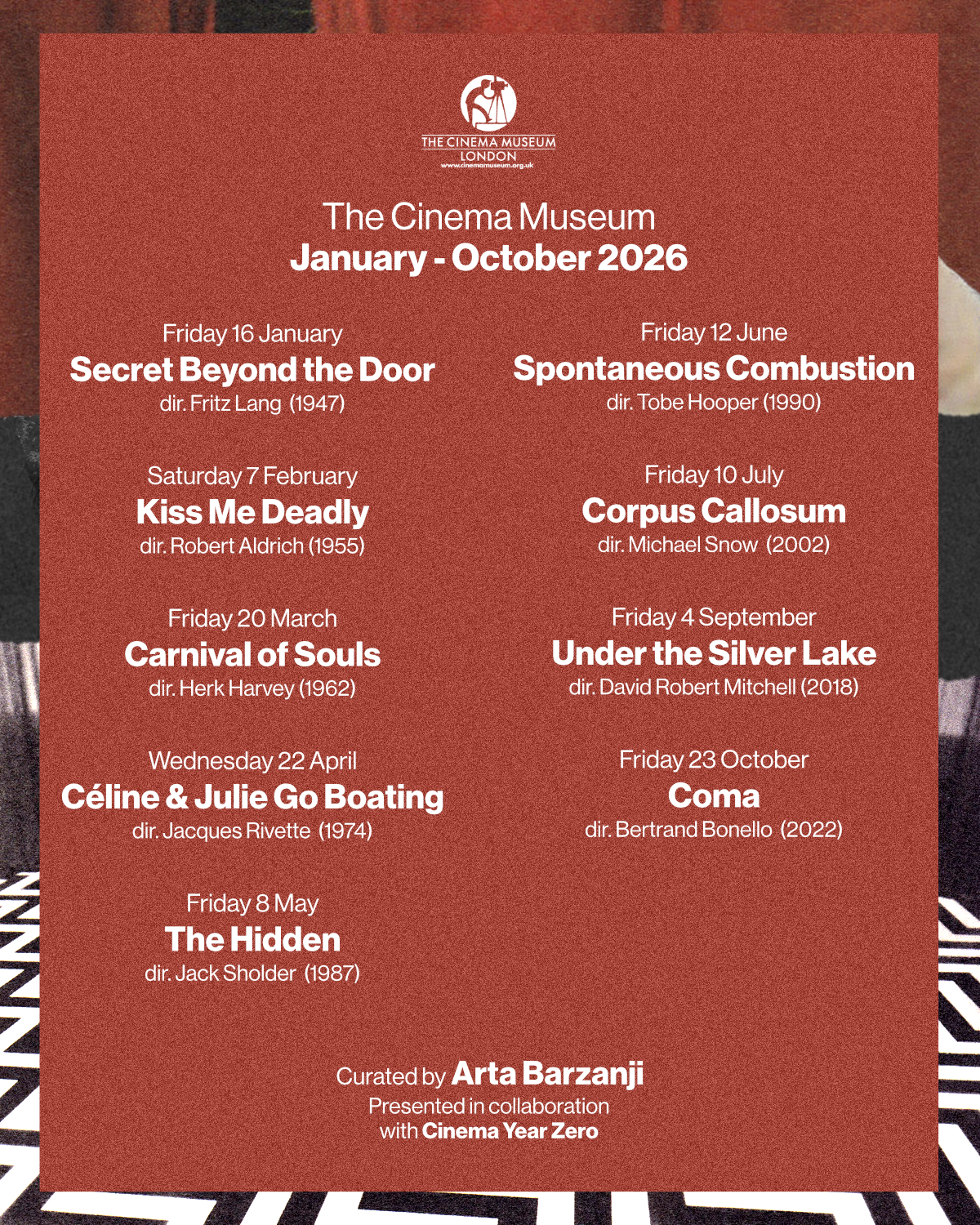
A nine-film season unfolding across 2026 at The Cinema Museum, London
Curated by Arta Barzanji
January–October 2026
Presented in collaboration with Cinema Year Zero
Cinema Year Zero season archive
The Cinema Museum season page
ABOUT THE SEASON
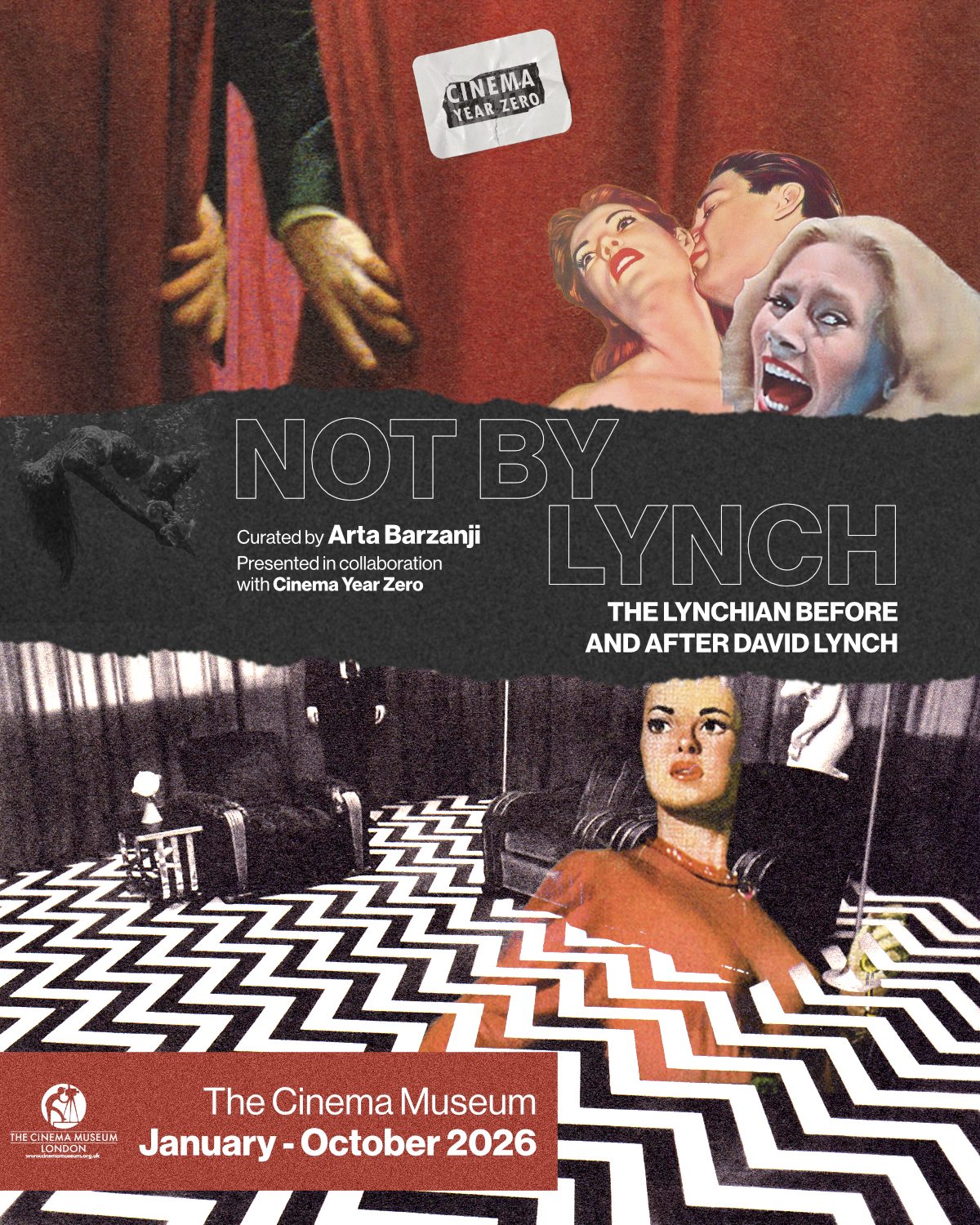
In Secret Beyond the Door, a house becomes the architectural expression of a disturbed inner life. Rooms preserve scenes of historical murders; one door remains locked. Fritz Lang’s psychological noir, brushing against the Bluebeard fairy tale, makes domestic respectability inseparable from obsession and violence. The opening film of Not By Lynch was made in 1947, long before David Lynch’s career began. Yet its corridors and thresholds already give form to something we have since learnt to call Lynchian.
The season brings together films made before, during and after Lynch’s career to examine this sensibility across different historical circumstances. Affinities between filmmakers are usually discussed through influence: who saw what, who borrowed an image, which formal decisions travelled from one film to another. Such histories are productive, but they cannot account for every echo. Parallels also emerge between works without a demonstrable line of inheritance. Different filmmakers, working across countries, decades and modes of production, can find themselves giving form to similar ways of perceiving and inhabiting the world.
“Lynchian” is especially revealing because it has escaped film culture. People use it to describe rooms, moods, political moments and personal experiences. It functions as a cultural shorthand, closer to “Kafkaesque” than to a conventional auteur adjective. This migration suggests that the word names an experience already felt beyond the films: the uneasy coexistence of familiar surroundings and profound instability. Lynch gave that experience one of its sharpest and most sustained expressions. His cinema made a structure of feeling recognisable without exhausting what it might mean.
To understand Lynch as a crystallisation of this sensibility is also to reconsider the relationship between an artist and history. Individuals do not produce the conditions of their work from nothing. They can become the point at which forces already in motion acquire a legible form. The Lynchian’s recurring tensions—between surfaces and depths, conscious and unconscious life, stable reality and its abrupt rupture—exceed the personal vocabulary of any one filmmaker. What appears securely ordered is continually threatened by what it excludes.
The particular force of these tensions in American cinema matters. The promises of democracy, equality and normality coexist with enduring structures of violence, domination and repression, at home and abroad. These contradictions are lived through domestic architecture, social rituals and media imagery. Lynch’s bright façades and monstrous interiors make their coexistence palpable. His films offer no programme for explaining or resolving them; their force comes from allowing us to inhabit the contradiction. The American films gathered here approach these pressures through very different forms. Their political circumstances matter without turning them into allegories whose images can be exchanged for a ready-made explanation.
The programme moves from classical Hollywood and regional independent production through European modernism, commercial genre cinema, experimental film and contemporary digital work. Lang’s haunted domestic interior gives way to the Los Angeles of Kiss Me Deadly, where a detective’s pursuit of a coveted object expands into an apocalyptic threat. Carnival of Souls makes ordinary public spaces feel depopulated and unresponsive. In The Hidden, malevolence passes between apparently ordinary bodies; in Spontaneous Combustion, the violence of a nuclear experiment persists within the body of the next generation. Each discovers a different relation between normality and what it represses.
Elsewhere, the instability belongs to the means by which a world is represented. Céline and Julie Go Boating treats narrative as a haunted house that can be entered, replayed and altered. Michael Snow’s *Corpus Callosum and Sshtoorrty make bodies, spaces and gestures vulnerable to the operations of the image itself. These films extend the inquiry beyond dread or resemblance. Play, repetition and formal experiment can unsettle reality as radically as a violent interruption. The spectator’s position, and the apparent reliability of what the screen presents, become part of the problem.
Under the Silver Lake and Coma bring the constellation into a world of media saturation, conspiracy culture and digital life. The search for concealed meanings and the porous boundary between screens and dreams give the Lynchian new conditions in which to operate. Across the season, the films remain distinct rather than becoming stages in a single genealogy. What recurs is a set of pressures on cinematic form: worlds that fracture, images that lose their stability, realities unable to contain what they have repressed.
The collaboration with Cinema Year Zero extends this inquiry through commissioned criticism. Programming already thinks through selection, sequence and the circumstances of viewing; writing can test those decisions, complicate their premises and preserve the questions a screening opens. The essays therefore accompany the films as arguments in their own right. This relationship matters within a repertory culture whose screenings can disappear without sustained critical documentation. Bringing criticism and programming into continuing contact allows the encounter to persist beyond its occasion, while leaving each film room to resist the terms through which it was introduced.
PROGRAMME
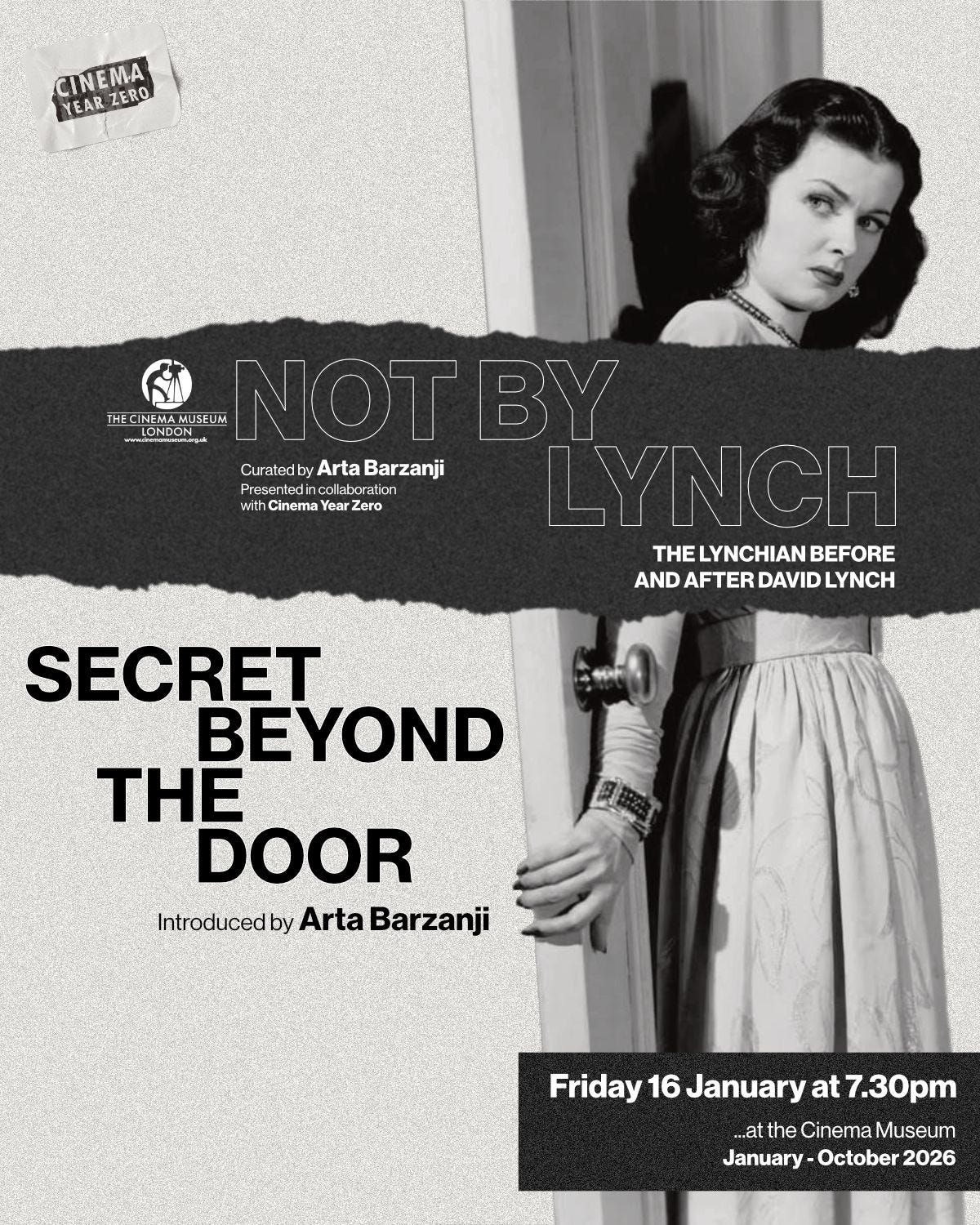
01 — Secret Beyond the Door
Fritz Lang / 1947 / 99 minutes
16 January 2026
Joan Bennett’s Celia impulsively marries an enigmatic architect and moves into his secluded country house. Inside, she discovers rooms meticulously arranged to reproduce historical murders; one remains locked. Lang turns the Bluebeard legend into a psychological noir in which marriage is also an encounter with an architecture of repressed desire. Drifting voiceover, expressionistic shadows and sudden flashbacks disturb the apparent solidity of the rooms through which Celia moves. The house’s respectable exterior gives no assurance about the fantasies organised within it. Opening the season with this film locates a dimension of the Lynchian inside classical Hollywood: the domestic interior as a space where intimacy, obsession and the threat of violence become inseparable.
Introduced by Arta Barzanji
Commissioned essay: The Mysterious World of Secret Beyond the Door — Alonso Aguilar
Cinema Year Zero
02 — Kiss Me Deadly
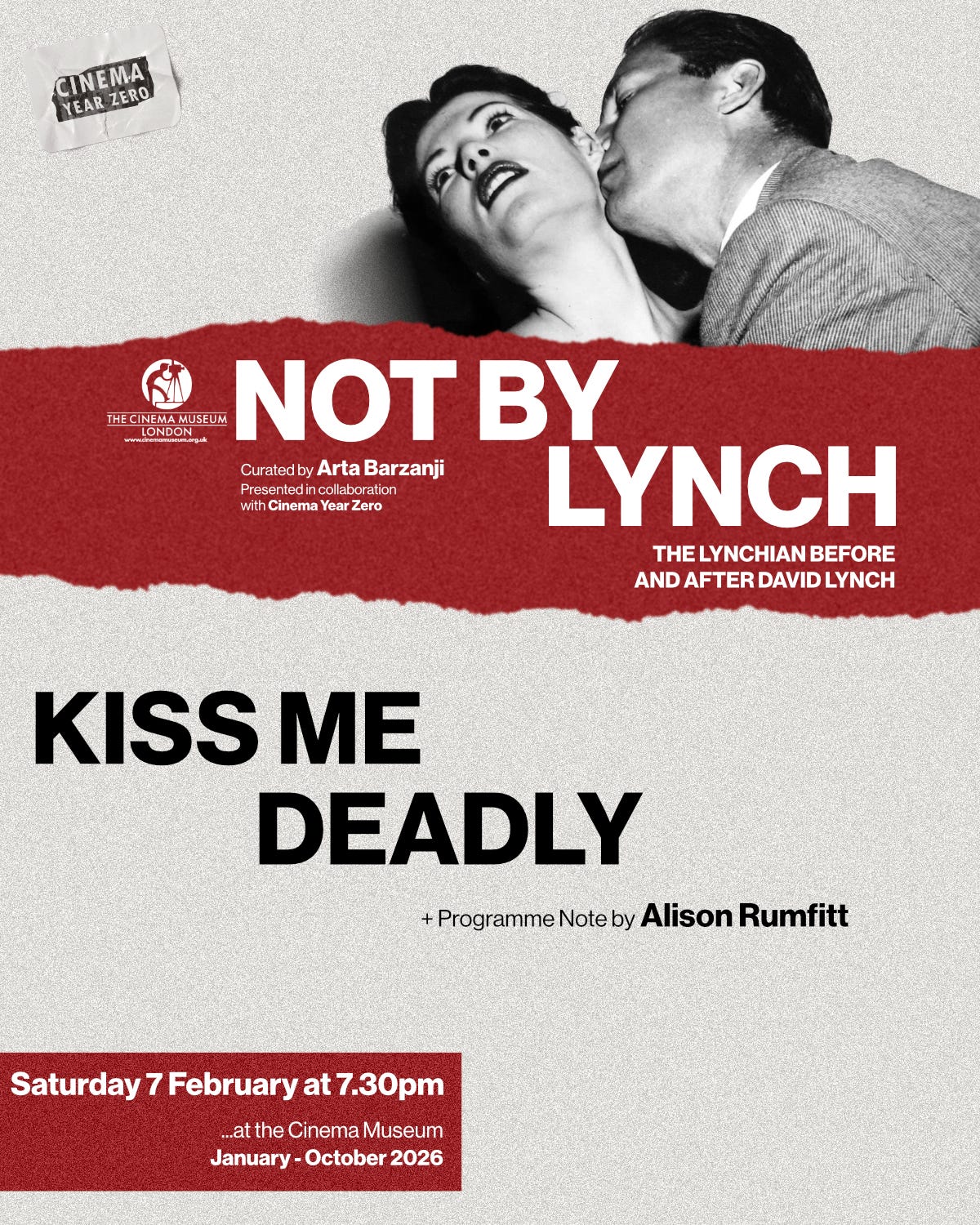
Robert Aldrich / 1955 / 106 minutes
7 February 2026
A terrified hitchhiker pulls private detective Mike Hammer into a pursuit whose object grows more dangerous as its meaning becomes less clear. Ralph Meeker’s Hammer is a thuggish opportunist, moving through a Los Angeles of gangsters, spies and escalating violence towards a coveted, glowing briefcase. Aldrich begins with the familiar machinery of a detective story, then drives it towards nuclear nightmare. Restless night journeys and abrupt eruptions of brutality make the city itself seem to fray. Placed alongside Lynch’s Los Angeles films, this noir reveals a shared pressure on the investigative narrative: the promised explanation at its centre may dissolve the world that made the search seem possible in the first place.
Introduced by Arta Barzanji
Commissioned essay: Gumshoe Apocalypse — Alison Rumfitt
Cinema Year Zero
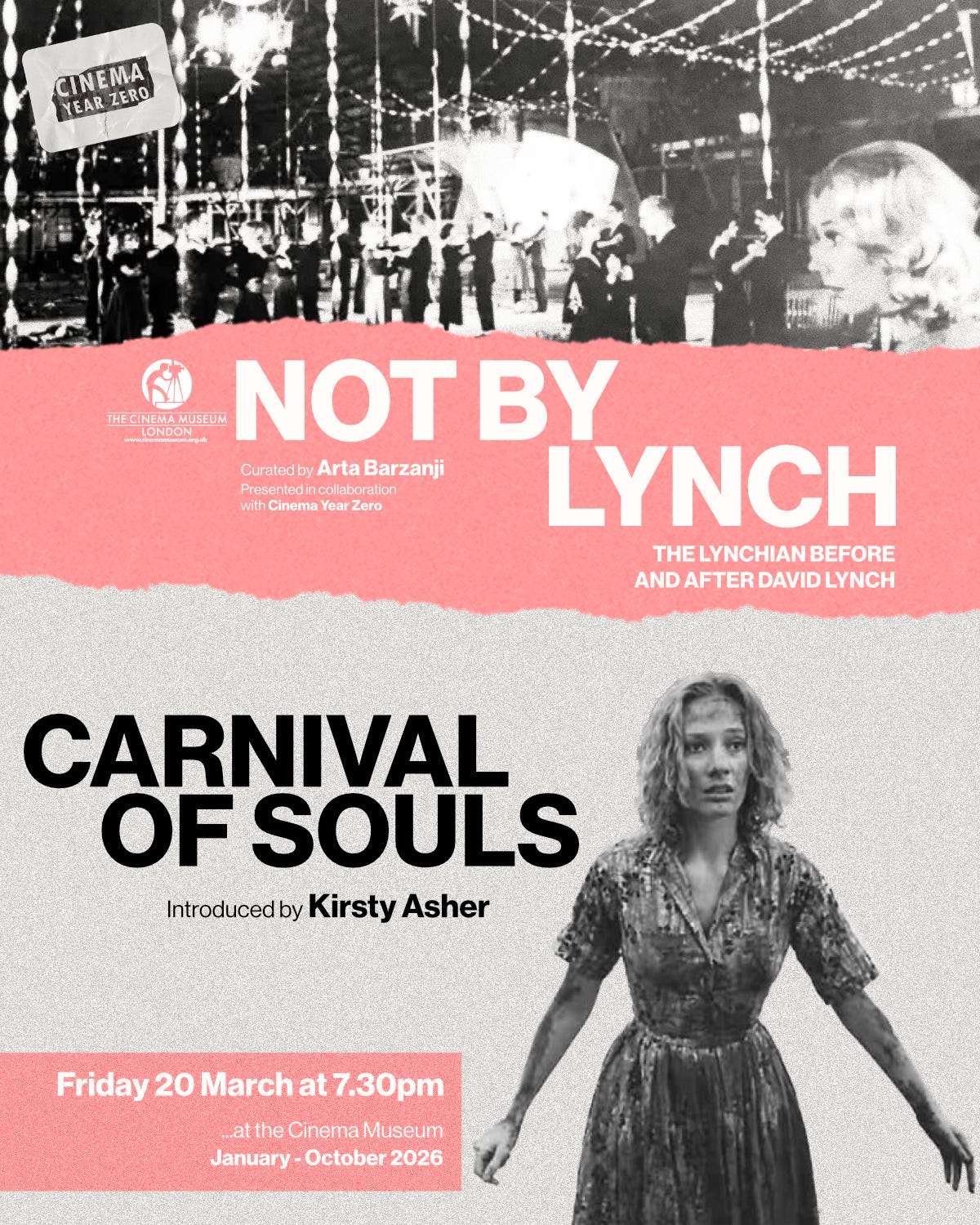
03 — Carnival of Souls
Herk Harvey / 1962 / 80 minutes
20 March 2026
After surviving a car crash, Mary, a church organist, moves to a new town. Strangers fail to acknowledge her, a pale, grinning man follows her, and an abandoned pleasure pavilion exerts an inexplicable attraction. Herk Harvey’s regional, low-budget horror turns the practical materials of its production—grainy black-and-white photography, empty streets, the derelict Saltair pavilion—into a world suspended between life and death. The organ score unsettles the spaces Mary crosses rather than reassuring us of their continuity. Her isolation becomes a disturbance in how the world responds to her presence. The film’s affinity with Lynch lies in this everyday dislocation: recognisable places persist, but the relations that should make them inhabitable have slipped.
Introduced by Kirsty Asher
Commissioned essay: Death’s Waiting Room — Kirsty Asher
Cinema Year Zero
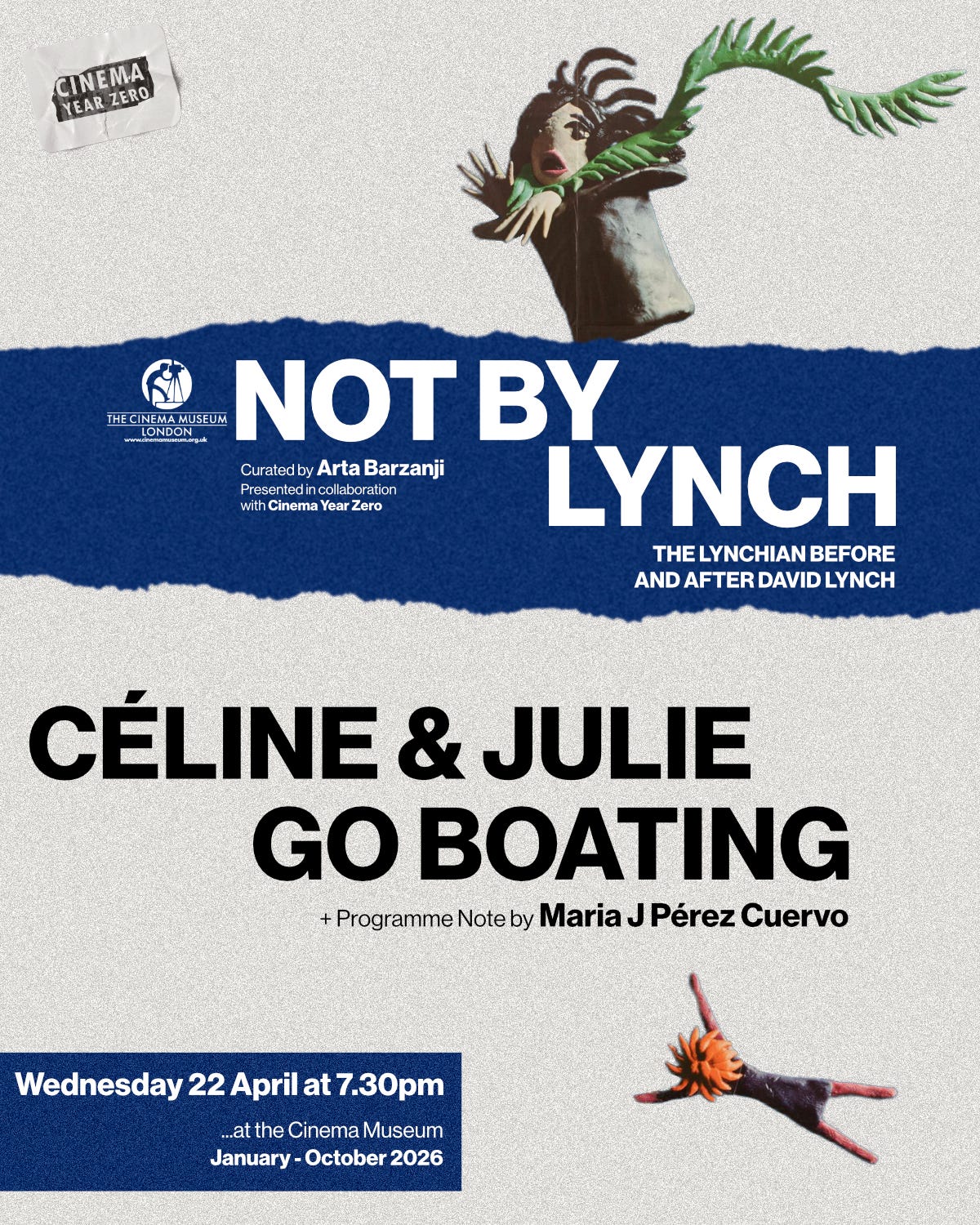
04 — Céline and Julie Go Boating
Jacques Rivette / 1974 / 192 minutes
22 April 2026
Librarian Julie and magician Céline begin a friendship through games, swapped identities and improvised performances. Their discoveries lead to a house where a gothic melodrama repeats itself. Enchanted sweets allow them to enter, watch and eventually intervene in its unfolding. Rivette makes narrative into a space that can be inhabited, remembered imperfectly and rewritten. The women’s play changes their position in relation to a story that initially seems to possess its own unalterable order. Its affinities with Mulholland Drive emerge through this traffic between identities and fictions, even as Rivette’s comic generosity gives the encounter a different temperature. Here the porous boundaries of reality offer possibilities for mischief and transformation alongside the haunted house’s repetitions.
Introduced by Arta Barzanji
Commissioned essay: The Triumph of Whimsy — Maria J. Pérez Cuervo
Cinema Year Zero
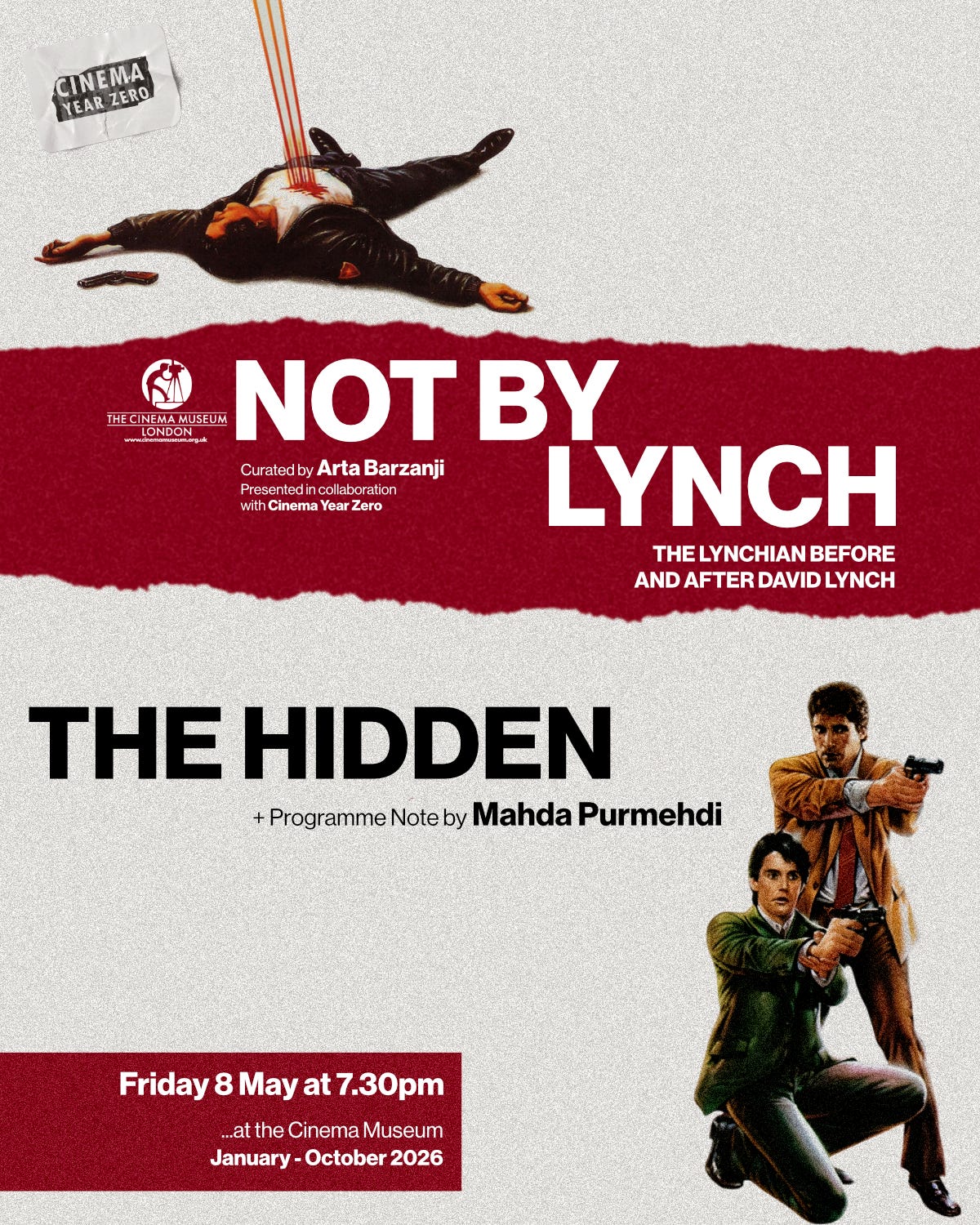
05 — The Hidden
Jack Sholder / 1987 / 97 minutes
8 May 2026
An alien parasite passes from one human host to another, turning ordinary Los Angeles citizens into violent, thrill-seeking criminals. The LAPD confronts an apparently senseless series of crimes until a soft-spoken FBI agent arrives with knowledge he cannot fully explain. Kyle MacLachlan’s performance gives the investigation an uncanny centre, several years before his appearance as Agent Cooper. Sholder’s commercial science-fiction thriller brings bodily possession into contact with the bland surfaces of offices and civic life. Familiar faces cease to guarantee a stable identity; spectacular violence can erupt through them without warning. The film’s place in the season rests on this movement between ordinary appearances and migrating malevolence, with the conventions of the cop thriller becoming a vehicle for uncertainty.
Introduced by Arta Barzanji
Commissioned essay: The Owls Are Not What They Seem: A Cinema of Echoes, a House of Mirrors — Mahda Purmehdi
Cinema Year Zero
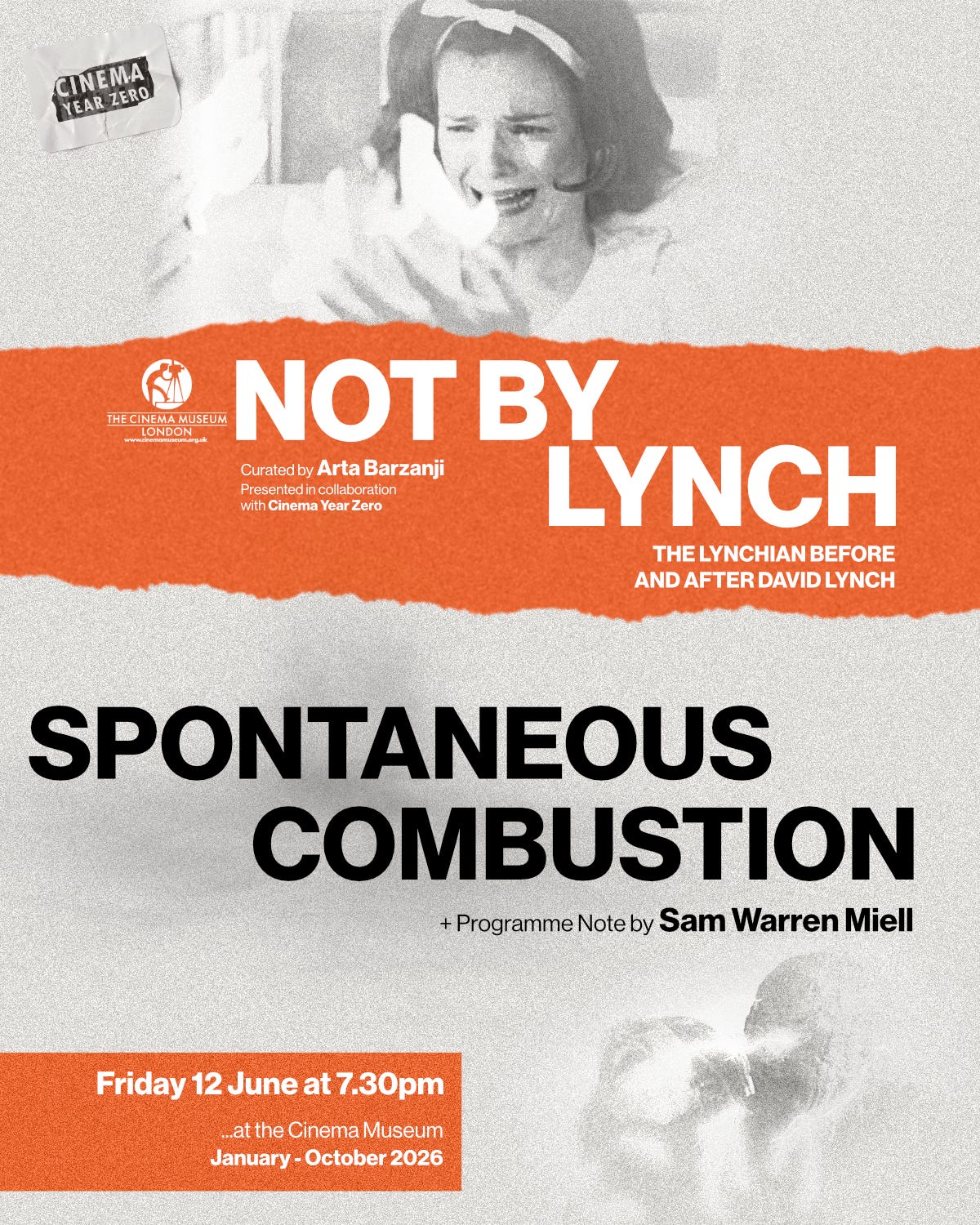
06 — Spontaneous Combustion
Tobe Hooper / 1990 / 97 minutes
12 June 2026
A secret nuclear experiment conducted on a couple in the 1950s finds its delayed consequences in their son. Decades later, the man, played by Brad Dourif, discovers that strong emotions trigger lethal bursts of flame. Hooper moves between melodrama, body horror and conspiracy thriller, making the historical experiment persist as an intimate, involuntary catastrophe. Dourif’s intensity holds these unstable registers together as the body becomes the site of forces it cannot master. Checkerboard floors, shadowy conspirators and sudden eruptions of energy create striking affinities with the atomic nightmares of Twin Peaks: The Return. The connection opens a way of thinking about nuclear anxiety and inherited violence across two filmmakers whose work repeatedly makes domestic life vulnerable to apparently boundless horror.
Introduced by Sam Warren Miell
Commissioned essay: Two in the shadows — Sam Warren Miell
Cinema Year Zero
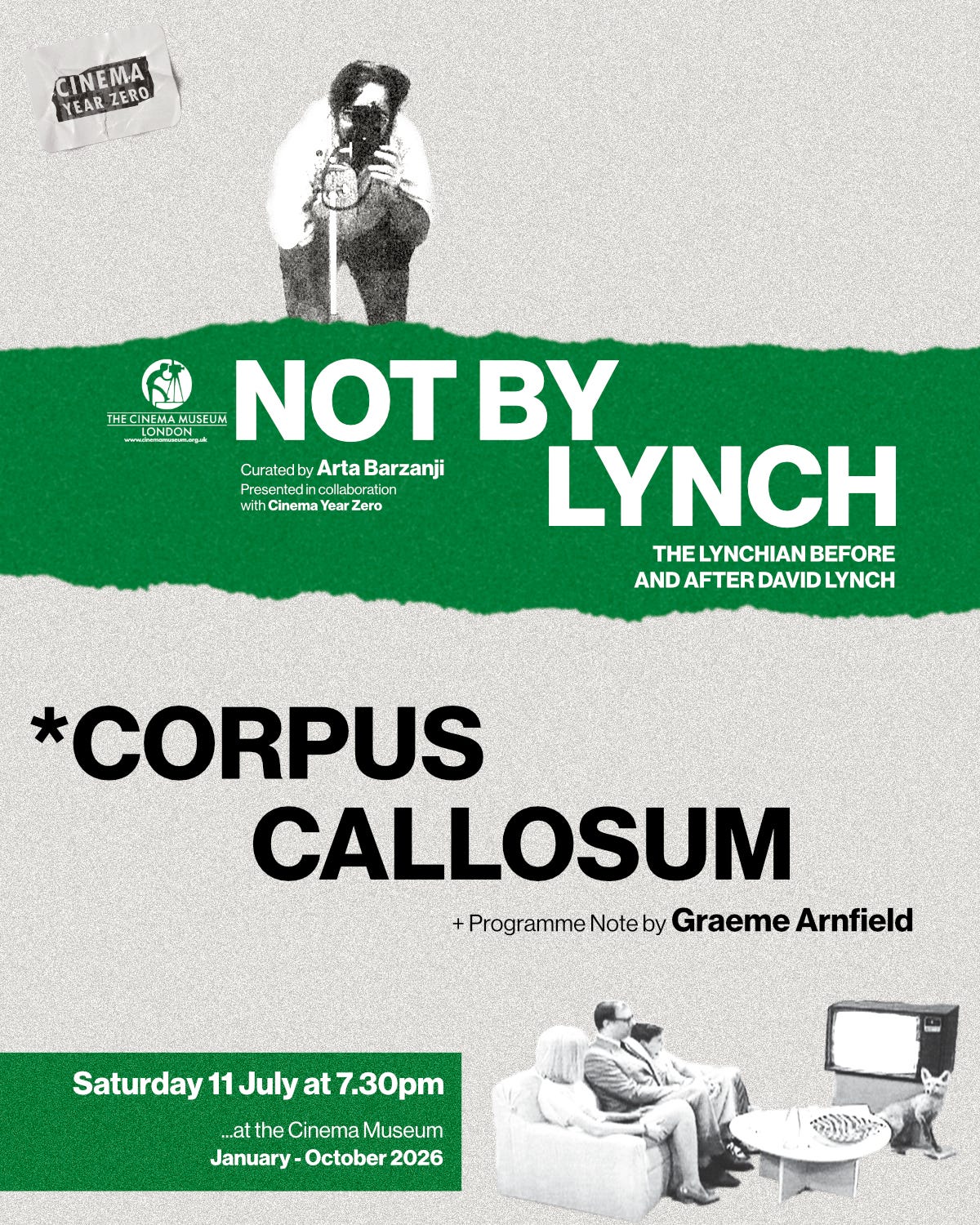
07 — *Corpus Callosum + Sshtoorrty
Michael Snow / 2002 / 2005 / 92 + 20 minutes
11 July 2026
In *Corpus Callosum, office workers and families occupy rooms whose physical laws are continually revised. Bodies, clothes and furniture distort; walls stretch and people duplicate. Digital manipulation makes the image appear to rewrite the reality it records, turning familiar interiors into sites of unruly play. The companion short, Sshtoorrty, superimposes two halves of a scene, folding a small drama into overlapping gestures and competing moments. Snow shifts the season’s inquiry towards the instability of representation itself. The affinities with Lynch’s Rabbits and Inland Empire arise through a shared willingness to let the image unsettle its own terms. The ordinary room becomes strange because the screen can no longer be trusted to hold its contents still.
Commissioned essay: Tough Bodies — Graeme Arnfield
Cinema Year Zero
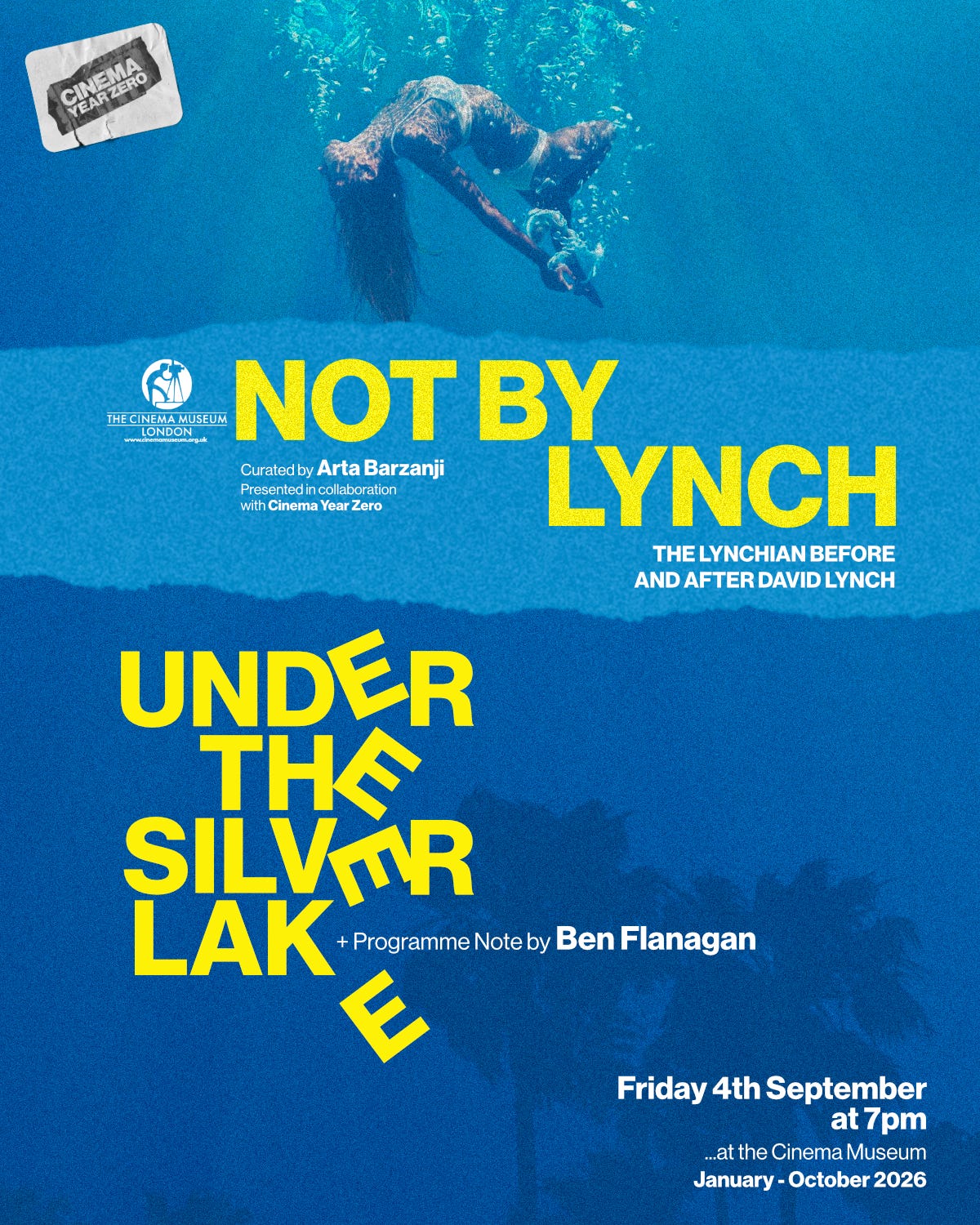
08 — Under the Silver Lake
David Robert Mitchell / 2018 / 139 minutes
4 September 2026
Sam, an unemployed Los Angeles dreamer, becomes convinced that his neighbour’s disappearance is connected to codes concealed throughout popular culture. His investigation takes him through parties, zines, underground bunkers and urban legends, each discovery promising access to another layer beneath the city’s surfaces. Mitchell turns the familiar neo-noir search into a satire of millennial conspiracism, in which the desire to decode may be as revealing as the clues themselves. Dreamy pacing and sinister glamour recall Lynch’s Los Angeles, but the film also registers the circulation of the Lynchian as a recognisable cultural vocabulary. Haunted Hollywood becomes a field of signs through which Sam wanders, increasingly unable to separate a hidden order from his own demand that one should exist.
Introduced by Ben Flanagan
Commissioned essay: Bro Code — Ben Flanagan
Cinema Year Zero
09 — Coma
Bertrand Bonello / 2022 / 80 minutes
23 October 2026 — Forthcoming
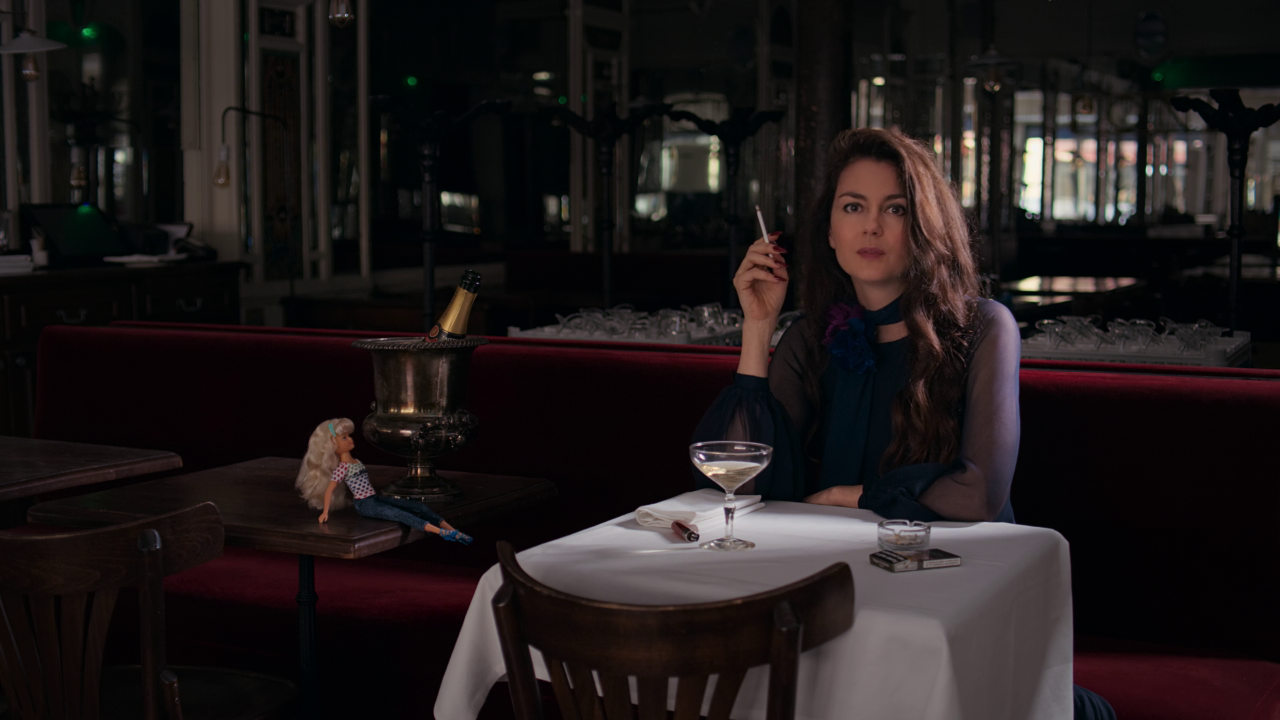
Made during the COVID-19 pandemic, Coma follows a teenage girl whose confinement brings screens, fantasies and dreams into increasingly unstable contact. YouTube gurus, plastic dolls and virtual forests belong to a world in which the apparent boundaries of domestic space no longer hold. Bonello moves between live action, animation and screenlife, allowing different kinds of images to interrupt and transform one another. The film carries the season’s inquiry into the conditions of digital life: an interior can remain physically enclosed while admitting an unmanageable flow of other spaces and voices. Its layered dreams and haunted everyday surroundings rework the Lynchian through the disorientation of lockdown, when mediated experience becomes inseparable from the texture of waking life.
Introduction: TBA
Commissioned essay: forthcoming
Screening information at The Cinema Museum · Cinema Year Zero season archive
COMMISSIONED WRITING
Commissioned writing forms a parallel strand of the season. A new essay accompanies each screening, distributed in a printed programme booklet and published through Cinema Year Zero. Together, these texts create a lasting critical archive alongside the events, allowing the films to be reconsidered through different writers’ arguments. Graeme Arnfield’s essay remains part of that archive despite the cancellation of the Michael Snow screening. The final commission, for Coma, is forthcoming.
The Mysterious World of Secret Beyond the Door
Alonso Aguilar is a Costa Rican writer, critic, programmer and audiovisual producer. His work has appeared in MUBI Notebook, Hyperallergic, Cinema Tropical, photogénie and other publications, and he is part of the Central American critics’ collective Krinégrafo.
Secret Beyond the Door
Gumshoe Apocalypse
Alison Rumfitt is a writer and cultural critic, and the author of the horror novels Tell Me I’m Worthless and Brainwyrms. Her criticism and journalism have appeared in publications including Little White Lies, Dazed and Rolling Stone.
Kiss Me Deadly
Death’s Waiting Room
Kirsty Asher is a film critic and editor at Cinema Year Zero. Her writing has appeared in MUBI Notebook, The Quietus and UK Film Review, and her criticism frequently engages with horror, contemporary cinema and film culture.
Carnival of Souls
The Triumph of Whimsy
Maria J. Pérez Cuervo is a writer and editor, and the founder and editor of Hellebore, a publication devoted to folklore, folk horror, myth, archaeology and the occult. Her work also spans film writing, publishing and criticism of the British weird.
Céline and Julie Go Boating
The Owls Are Not What They Seem: A Cinema of Echoes, a House of Mirrors
Mahda Purmehdi is an experimental filmmaker, writer and educator working across 16mm, Super 8 and digital video. His practice explores image-making, memory, archives and film history, and he is currently pursuing a practice-based PhD in Media Study at the University at Buffalo.
The Hidden
Two in the Shadows
Sam Warren Miell is a London-based writer and translator working on film and art, and a member of the editorial board of Narrow Margin. His writing moves between classical Hollywood and experimental cinema, alongside translation work on French film criticism.
Spontaneous Combustion
Tough Bodies
Graeme Arnfield is a London-based artist filmmaker, curator and composer whose essay films use found and networked imagery to investigate technology, ecology, circulation and history. His work has screened internationally at venues and festivals including Berlinale Forum Expanded, IFFR and Courtisane.
*Corpus Callosum + Sshtoorrty
Bro Code
Ben Flanagan is a London-based critic and programmer, and co-founder and editor-in-chief of Cinema Year Zero. His writing has appeared in outlets including MUBI Notebook and Little White Lies, with a particular interest in repertory cinema and film culture.
Under the Silver Lake
Forthcoming — Coma
Essay title and author to be announced.
Cinema Year Zero season archive
ABOUT THE PROJECT
I proposed Not By Lynch to The Cinema Museum as a serial programme extending across the year. Its historically layered interiors offered a fitting setting for films concerned with unstable rooms, haunted spaces and uneasy histories. The collaboration with Cinema Year Zero gave the series a continuing critical framework, with each selection becoming an occasion for a new piece of writing and a return to the questions posed by the season.
Original posters, trailers, printed programme booklets, commissioned essays and introductions form part of the curatorial work. They shape how a film is encountered and what remains of that encounter afterwards. The serial structure allows these materials and arguments to accumulate, connecting individual evenings across the months. This page gathers the programme and its published writing in one place, preserving material that would otherwise be dispersed or ephemeral and connecting repertory exhibition with sustained critical documentation.
CREDITS
Curator — Arta Barzanji
Presented by — The Cinema Museum
In collaboration with — Cinema Year Zero
Posters — Jeremy Arblaster